
Three worked Studio TikZ diagrams
By Wildan Bagus Wicaksono · Homepage
Read each problem alongside its figure and TikZ. Use the links below the illustrations to drag the original points in Studio. The construction steps follow the gallery.
Studio TikZ examples
Here are three diagrams I use when teaching olympiad geometry. Read the TikZ alongside each figure, or open the construction in Studio and drag its points.
LaTeX packages
Place these two lines before \begin{document}. The dvipsnames option supplies the named colours used in these diagrams.
\usepackage[dvipsnames]{xcolor}
\usepackage{tikz}
Examples 1 and 3 use \usetikzlibrary{angles} for the angle arcs. The line is included in each code sample.
1. A reflection and two cyclic quadrilaterals
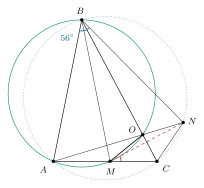
Let $M$ lie on $\overline{AC}$ in triangle $ABC$. Reflect $M$ across $BC$ to obtain $N$. Line $AN$ meets $\overline{BC}$ at $O$, and $A,B,M,O$ are concyclic. If $\angle ABN=56^\circ$, find $\angle CMN$.
TikZ code
\usetikzlibrary{angles}
\begin{center}
\begin{tikzpicture}[scale=1, font=\small]
    \coordinate (A) at (0, 0);
    \path (A) ++(-0.36, -0.29) node[inner sep=0pt] {$A$};
    \coordinate (B) at (1, 5);
    \path (B) ++(-0.055, 0.32) node[inner sep=0pt] {$B$};
    \coordinate (M) at (2, 0);
    \path (M) ++(0.025, -0.35) node[inner sep=0pt] {$M$};
    \coordinate (C) at (3.65855, 0);
    \path (C) ++(0.33, -0.25) node[inner sep=0pt] {$C$};
    \coordinate (N) at (4.58599, 1.375);
    \path (N) ++(0.32, 0.05) node[inner sep=0pt] {$N$};
    \coordinate (O) at (3.1555, 0.9461);
    \path (O) ++(-0.37, 0.18) node[inner sep=0pt] {$O$};

    \draw[semithick, PineGreen] (1, 2.4) circle (2.6);
    \draw[semithick, MidnightBlue, opacity=0.8, dotted] (1.82927, 2.23415) circle (2.8875);
    \draw[semithick] (A)--(B);
    \draw[semithick] (B)--(C);
    \draw[semithick] (C)--(A);
    \draw[thin] (A)--(N);
    \draw[thin] (B)--(M);
    \draw[thin] (B)--(N);
    \draw[thin] (N)--(C);
    \draw[semithick, BrickRed, dashed] (M)--(N);
    \draw[thick] (M)--(O);
    \pic[draw=MidnightBlue, thick, angle radius=0.39cm] {angle=A--B--N};
    \node[inner sep=0pt, text=MidnightBlue] at (0.49, 4.38) {$56^{\circ}$};
    \pic[draw=BrickRed, thick, angle radius=0.39cm] {angle=C--M--N};

    % Keep printed point radius at 1.5pt when scale changes.
    \pgfgettransformentries{\studioXX}{\studioYX}{\studioXY}{\studioYY}{\studioDX}{\studioDY}
    \pgfmathsetlengthmacro{\studioRadiusTitik}{1.5pt/veclen(\studioXX,\studioYX)}
    \foreach \s in {A,B,M,C,N,O}
        \filldraw (\s) circle (\studioRadiusTitik);
\end{tikzpicture}
\end{center}
2. Three circles on the medians
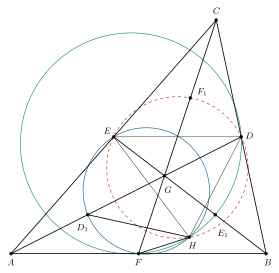
Let $G$ be the centroid of triangle $ABC$. Let $D,E,F$ be the midpoints of $BC,CA,AB$, respectively, and $D_1,E_1,F_1$ the midpoints of $AG,BG,CG$. Prove that the circumcircles of $D_1EF$, $DE_1F$ and $DEF_1$ have a common point.
TikZ code
\begin{center}
\begin{tikzpicture}[scale=1, font=\small]
    \coordinate (A) at (0, 0);
    \path (A) ++(-0.008, -0.3) node[inner sep=0pt] {$A$};
    \coordinate (B) at (9, 0);
    \path (B) ++(0.06, -0.303) node[inner sep=0pt] {$B$};
    \coordinate (C) at (7.24, 8.24);
    \path (C) ++(0.008, 0.33) node[inner sep=0pt] {$C$};
    \coordinate (D) at (8.12, 4.12);
    \path (D) ++(0.287, 0.04) node[inner sep=0pt] {$D$};
    \coordinate (E) at (3.62, 4.12);
    \path (E) ++(-0.223, 0.215) node[inner sep=0pt] {$E$};
    \coordinate (F) at (4.5, 0);
    \path (F) ++(-0.009, -0.3) node[inner sep=0pt] {$F$};
    \coordinate (G) at (5.41333, 2.74667);
    \path (G) ++(0.123, -0.495) node[inner sep=0pt] {$G$};
    \coordinate (D1) at (2.70667, 1.37333);
    \path (D1) ++(-0.184, -0.454) node[inner sep=0pt] {$D_{1}$};
    \coordinate (E1) at (7.20667, 1.37333);
    \path (E1) ++(0.266, -0.658) node[inner sep=0pt] {$E_{1}$};
    \coordinate (F1) at (6.32667, 5.49333);
    \path (F1) ++(0.415, 0.221) node[inner sep=0pt] {$F_{1}$};
    \coordinate (H) at (6.28748, 0.5786);
    \path (H) ++(0.116, -0.287) node[inner sep=0pt] {$H$};

    \draw[semithick, MidnightBlue] (4.77139, 2.21195) circle (2.22853);
    \draw[semithick, PineGreen] (4.22861, 3.8888) circle (3.89825);
    \draw[semithick, BrickRed, dashed] (5.87, 3.03945) circle (2.49601);
    \draw[thick] (A)--(B);
    \draw[thick] (B)--(C);
    \draw[thick] (C)--(A);
    \draw[thick] (A)--(D);
    \draw[thick] (B)--(E);
    \draw[thick] (C)--(F);
    \draw[thin] (D)--(E);
    \draw[thin] (E)--(H);
    \draw[thin] (H)--(D);
    \draw[thick] (D1)--(H);
    \draw[thick] (H)--(F);

    % Keep printed point radius at 1.5pt when scale changes.
    \pgfgettransformentries{\studioXX}{\studioYX}{\studioXY}{\studioYY}{\studioDX}{\studioDY}
    \pgfmathsetlengthmacro{\studioRadiusTitik}{1.5pt/veclen(\studioXX,\studioYX)}
    \foreach \s in {A,B,C,D,E,F,G,D1,E1,F1,H}
        \filldraw (\s) circle (\studioRadiusTitik);
\end{tikzpicture}
\end{center}
3. A tangent and two medians
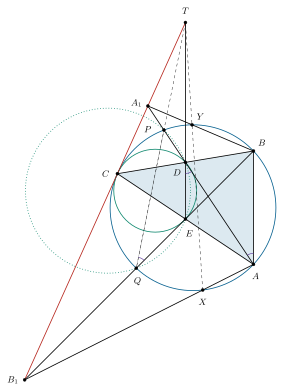
Let $\ell$ be the tangent at $C$ to the circumcircle of a non-isosceles triangle $ABC$. Let $D$ and $E$ be the midpoints of $BC$ and $CA$. Lines $AD$ and $BE$ meet $\ell$ at $A_1$ and $B_1$. Line $AB_1$ meets the circumcircle again at $X$, and $BA_1$ meets it again at $Y$. Prove that $X,Y,D,E$ are concyclic.
TikZ code
\usetikzlibrary{angles}
\begin{center}
\begin{tikzpicture}[scale=0.8, font=\small]
    \fill[fill=MidnightBlue, fill opacity=0.14] (0, 0)--(0, 5)--(-6, 4)--cycle;
    \coordinate (A) at (0, 0);
    \path (A) ++(0.09, -0.512) node[inner sep=0pt] {$A$};
    \coordinate (B) at (0, 5);
    \path (B) ++(0.368, 0.368) node[inner sep=0pt] {$B$};
    \coordinate (C) at (-6, 4);
    \path (C) ++(-0.52, 0) node[inner sep=0pt] {$C$};
    \coordinate (D) at (-3, 4.5);
    \path (D) ++(-0.373, -0.444) node[inner sep=0pt] {$D$};
    \coordinate (E) at (-3, 2);
    \path (E) ++(0.168, -0.628) node[inner sep=0pt] {$E$};
    \coordinate (A1) at (-4.65672, 6.98507);
    \path (A1) ++(-0.502, 0.135) node[inner sep=0pt] {$A_{1}$};
    \coordinate (B1) at (-10.09091, -5.09091);
    \path (B1) ++(-0.52, 0) node[inner sep=0pt] {$B_{1}$};
    \coordinate (T) at (-3, 10.66667);
    \path (T) ++(0, 0.52) node[inner sep=0pt] {$T$};
    \coordinate (P) at (-3.94872, 5.92308);
    \path (P) ++(-0.715, 0.04) node[inner sep=0pt] {$P$};
    \coordinate (Q) at (-5.16667, -0.16667);
    \path (Q) ++(0.051, -0.578) node[inner sep=0pt] {$Q$};
    \coordinate (X) at (-2.24054, -1.13036);
    \path (X) ++(0, -0.52) node[inner sep=0pt] {$X$};
    \coordinate (Y) at (-2.70955, 6.15503);
    \path (Y) ++(0.368, 0.368) node[inner sep=0pt] {$Y$};

    \draw[thick, MidnightBlue] (-2.66667, 2.5) circle (3.65529);
    \draw[thick, PineGreen, dotted] (-6.41667, 3.25) circle (3.63815);
    \draw[thick, PineGreen] (-4.33333, 3.25) circle (1.82764);
    \draw[thick] (A)--(B);
    \draw[thick] (B)--(C);
    \draw[thick] (C)--(A);
    \draw[thick] (A)--(A1);
    \draw[thick] (B)--(B1);
    \draw[thick, BrickRed] (B1)--(T);
    \draw[thin, dashed] (X)--(T);
    \draw[thin, dashed] (T)--(Q);
    \draw[thick] (E)--(T);
    \draw[thick] (B1)--(A);
    \draw[thick] (B)--(A1);
    \draw[thin, opacity=0.45] (Q)--(P);
    \pic[draw=RoyalPurple, semithick, angle radius=0.39cm] {angle=E--Q--P};
    \pic[draw=RoyalPurple, semithick, angle radius=0.39cm] {angle=E--D--A};
    \pic[draw=RoyalPurple, semithick, angle radius=0.39cm] {angle=B--A--D};

    % Keep printed point radius at 1.5pt when scale changes.
    \pgfgettransformentries{\studioXX}{\studioYX}{\studioXY}{\studioYY}{\studioDX}{\studioDY}
    \pgfmathsetlengthmacro{\studioRadiusTitik}{1.5pt/veclen(\studioXX,\studioYX)}
    \foreach \s in {A,B,C,D,E,A1,B1,T,P,Q,X,Y}
        \filldraw (\s) circle (\studioRadiusTitik);
\end{tikzpicture}
\end{center}
Construct the reflection diagram
- Choose Point and click two blank spots to create $A$ and $B$. Make a counterclockwise $56^\circ$ arc centred at $B$, starting at $A$. Choose Point again. Click the other endpoint of the arc for $T$, then click the arc between $A$ and $T$ to place $M$.
- Mark the midpoint $H$ of $MT$. Draw $BH$ and $AM$, and call their intersection $C$. Choose Polygon, click $A$, $B$ and $C$, then press Enter to close the triangle. Since $BM=BT$, line $BC$ is the perpendicular bisector of $MT$.
- Choose Reflection, click $M$, then click line $BC$ to obtain $N$, coincident with $T$. Intersect $AN$ with $BC$ at $O$. Draw a solid
PineGreencircle through $A,B,M$ and a dottedMidnightBluecircle through $A,B,C$. - Add $BM,BN,CN$, a dashed
BrickRedsegment $MN$, and a heavier segment $MO$. With Angle, mark $\angle ABN$ with an automatic measure and $\angle CMN$ with a red arc. Hide the auxiliary arc, lines, $T$ and $H$. Drag $M$ along its arc and check that the measure at $B$ stays at $56^\circ$.
Download the editable project · Download the TikZ
Construct the three circles on the medians
- Choose Polygon, click $A$, $B$ and $C$, then click $A$ again to close the triangle. Mark the midpoints $D,E,F$ of $BC,CA,AB$. Draw medians $AD,BE,CF$. Intersect the first two to obtain $G$.
- Mark the midpoints $D_1,E_1,F_1$ of $AG,BG,CG$. Draw the three-point circles through $(D_1,E,F)$, $(D,E_1,F)$ and $(D,E,F_1)$.
- The first two circles meet at $F$ and $H$. In the downloadable construction, $H$ is the reflection of $F$ across the line of their centres. This keeps the intended intersection as the triangle changes. Hide the centres and the mirror line.
- Add $DE,EH,HD,D_1H,HF$. Move the labels a little where several lines cross. Try the translucent label background if space is tight. Drag $C$ and observe $H$ on the third circle.
Download the editable project · Download the TikZ
Construct the tangent and the medians
- Use Polygon to draw $ABC$ and press Enter after the third vertex. Fill $ABC$ with
MidnightBlueat 14% opacity, then draw its blue circumcircle. Construct the midpoints $D$ of $BC$ and $E$ of $CA$. Draw the full lines $AD$ and $BE$. - Construct the tangent $\ell$ at $C$. Intersect it with $AD$, $BE$ and $DE$ to obtain $A_1$, $B_1$ and $T$. Use a
BrickRedsegment from $B_1$ to $T$ to show the tangent. - Intersect $AB_1$ and $BA_1$ again with the circumcircle to find $X$ and $Y$. Use $AD$ and $BE$ similarly for their second intersections $P$ and $Q$.
- Draw a dotted
PineGreencircle through $D,E,P$ and a solid one through $C,D,E$. Draw $XT,TQ$ dashed and $QP$ thin. Use Angle to mark $\angle EQP$, $\angle EDA$ and $\angle BAD$ inRoyalPurple.
Vary the triangle’s fill opacity and inspect the corresponding fill opacity=0.14 in the initial TikZ. In the object list, reveal the hidden circle through $D,E,X$. Move a triangle vertex and observe $Y$ on this circle. Fit the diagram to see its whole circumference.